
Community Roundtable with Israeli Ambassador to the United States Dr. Yechiel Leiter
Tuesday, September 1, 2026 - Shreveport, Louisiana
It was an honor to welcome two Israeli dignitaries to Shreveport on September 1. Leaders from our Jewish community had the opportunity to meet the new Consul General of Israel to the Southwest, Adi Farjon Israel, and be part of a roundtable discussion with the Israeli Ambassador to the United States, Dr. Yechiel Leiter.
Consul General Adi Farjon Israel has just begun her term as Consul General of Israel to the Southwest, and we appreciated the opportunity to meet her and discuss future opportunities. We look forward to her next visit.
Questions from our group to the Ambassador covered a range of topics, and while there was not time to address them all, voicing them let the Ambassador, Consul General, and members of their staffs know our concerns about our Israeli family.
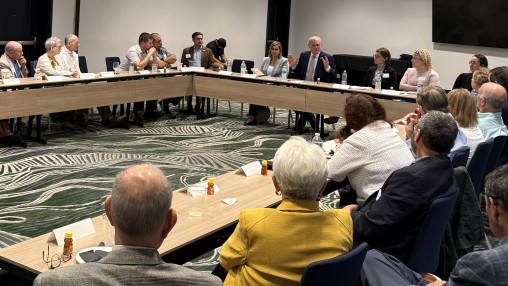
A report from the Community Roundtable with Ambassador Leiter:
Israel's security struggles extend far beyond the past three years, reaching back through centuries of Jewish history since the time of Abraham. Throughout generations of exile, rabbinic scholars consistently recorded the passage of time by counting the years spent away from the land, reaffirming an enduring yearning to return home. Modern Zionism is rooted in this deep historical connection rather than being a recent invention, yet as the sole democracy in the Middle East, Israel continues to face hostility from regional adversaries opposing its democratic values.
Reflecting on political theory, Francis Fukuyama famously posited in The End of History and the Last Man that Western liberal democracy represented the final form of human government—a concept dramatically challenged by the events of September 11.
Drawing on historian Bernard Lewis’s insightful work, the Ambassador explained that just as Christianity underwent a major reformation 1,500 years after Jesus, the Islamic world is currently navigating its own historical pivot. Today, a significant realignment is emerging wherein regional powers choose accommodation with Judeo-Christian civilization over conflict—a shift exemplified by the landmark Abraham Accords and a growing recognition of Israel.
In response to these diplomatic advances, Iran escalated its efforts to dismantle the Jewish state through a strategic "Ring of Fire," encircling Israel with hostile proxy forces including Hezbollah, Iranian-backed militias in Syria and Iraq, the Houthis, and Hamas. To counter these existential threats, Israel allocates 8% of its GDP to national defense.
To protect its citizens, Israel relies on a multi-tiered defense architecture comprising five missile defense systems, which successfully intercept 88% of incoming ballistic threats. One of the systems was developed in close partnership with the United States.
Addressing the October 7 attack, the Ambassador noted that Yahya Sinwar launched the assault prematurely; had Hamas coordinated simultaneously with other regional proxies, the devastation could have been far worse. In the aftermath, Israel’s younger generation stepped forward with profound resolve and personal responsibility.
Turning to the alarming surge in global antisemitism, the Ambassador forcefully rejected the false allegation of genocide. Pointing to recent data, such as UNICEF metrics on Gaza’s youth population and rates of obesity, he highlighted that the combatant-to-civilian casualty ratio in Gaza remains lower than in urban conflicts like Fallujah or Mosul, with population movements intended to protect civilians. While acknowledging that fringe political voices within Israel occasionally utter irresponsible statements, he noted that such friction is an inherent challenge of democratic governance—far preferable to authoritarian alternatives.
Characterizing much of the biased media coverage as a modern-day blood libel, the Ambassador recommended the Embassy’s book Manufacturing a Modern Blood Libel, emphasizing how exhausting it is for Israeli representatives to continuously defend basic truths.
Israel has implemented a new defense doctrine based on a firm requirement: Hamas must completely disarm, as Israel will no longer tolerate jihadi threats on its borders. Temporary security buffer zones have been established in Gaza, Lebanon, and Syria strictly for defensive purposes, not annexation—similar to buffer zones maintained by Turkey in Syria. In southern Lebanon, a perimeter of 8 to 10 kilometers counters short-range anti-tank missiles and terror tunnels, alongside emerging threats like incoming armed drones.
As Israel’s lead negotiator regarding Lebanon, Ambassador Leiter shared that active diplomatic efforts are underway toward long-term peace. Although Hezbollah’s presence remains a major obstacle, negotiators are proactively laying the groundwork for future stability.
Amid widespread global social change and disinformation spread via podcasters and social media, Zionism makes no extraordinary demands—it simply insists that Israel receive the same respect and rights accorded to any sovereign nation.
Domestically, most Israelis favor a broad-based unity government as the nation continues to process collective trauma, finding inspiration and hope in the unity shown by the younger generation.
U.S.–Israel strategic collaboration has reached unprecedented levels, and the Ambassador expressed hope that this partnership will expand to tackle broader challenges like global food insecurity. He expressed deep gratitude for key leaders such as Louisiana’s Mike Johnson and Steve Scalise. Looking ahead to the upcoming Memorandum of Understanding, he noted that the current $3.8 billion defense agreement predominantly reinvests $3.3 billion directly into American manufacturing and local economies.
Regarding extremist violence in the West Bank, the Ambassador firmly condemned all acts of violence while noting that Palestinian attacks occur at higher frequencies. Reaffirming that lawlessness must never be excused, he referenced his explicit public condemnation in this recent Ha'artez article.
Improving Israel’s public relations diplomacy requires long-term effort. Referencing Dara Horn’s book People Love Dead Jews, the Ambassador observed that conventional Holocaust education has inadvertently conditioned the world to accept Jewish vulnerability, emphasizing that Israel was established through Jewish resilience rather than as a byproduct of tragedy.
He recommended The Case for Dual Loyalty: Healing the Divided Soul of American Jews by Nolan Lebovitz.
Additionally, Ambassador Leiter co-authored an upcoming book with a student from George Washington University titled Of Good Courage: Israel and the West’s Fight for Moral Clarity, scheduled for release in February.
While in Northwest Louisiana, the Ambassador and Counsel General also had meetings with the Coushatta Tribe of Louisiana, the first federally recognized tribe to establish formal ties with Israel, and several events with Cypress Baptist Church, including an interview with Pastor John Fream on his podcast Traits of a Champion.
Related Reading: An Honest Conversation about Israel with Sharon Banyan