
Reflections on the 2025 General Assembly
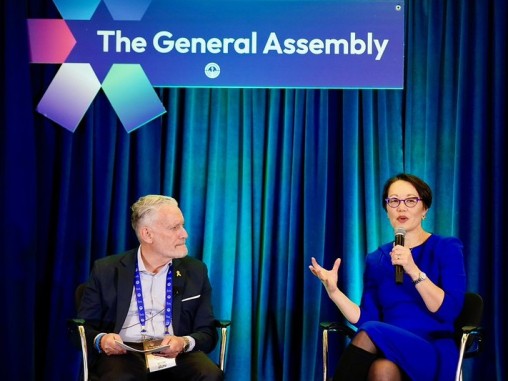
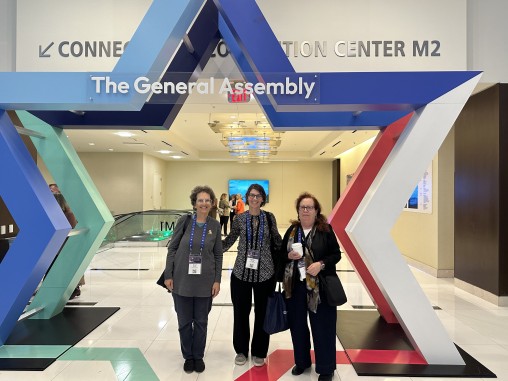
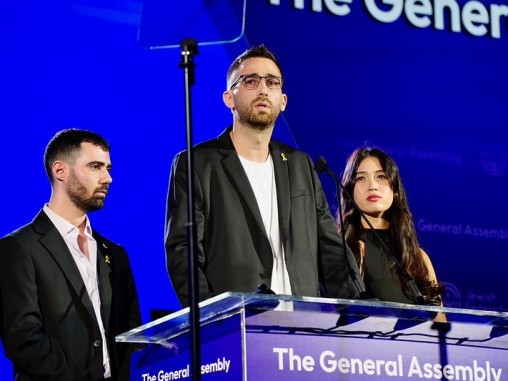
More than 2,000 Jewish leaders gathered in Washington, DC last month for Jewish Federations of North America’s General Assembly, where we heard powerful stories from former hostages, a bipartisan call to confront rising antisemitism, and major updates on our community’s long-term plans.
I am especially proud of the delegation that represented our North Louisiana community. Led by our Board President, Ellen Soffer, we were joined by Endowment Committee member Susan Gross. Whether it was networking with other communities, dividing and conquering different sessions, or sitting together in the plenary events, our group showed up with curiosity, enthusiasm, and a true commitment to learning.
The GA gave us a chance to step back from the day-to-day and reconnect with the bigger picture: the values we share, the challenges we’re facing, and the future we’re building together. Hearing from communities across North America helped us see our own work in North Louisiana with fresh eyes. It sparked new thinking, encouraged collaboration, and renewed our sense of purpose.
You can explore all the moments and standout speakers at the General Assembly Highlights page. Let me know if I can direct you to something specific – there’s a lot!
Below are some details that I felt were worthy of sharing, with some recurring themes in bold print.
Plenary Sessions
In the opening plenary, the stated priorities for the gathering were identified as Israel’s rebuilding, rising antisemitism, and sustaining the “Surge” in Jewish engagement. We heard many inspiring voices in this opening session, including those of four recently released hostages, one of whom said: “No one can take your mind or humanity.”
Other highlights of the opening plenary:
- Sarah Hurwitz, author and former White House speech writer, noted that Holocaust education is essential, but it might be confusing now. The images of the powerful and powerless need more context in this era of anti-Zionism, and we are still feeling the impact of a history of Soviet anti-Semitism. This generation needs a foundation of Jewish history and traditions. Returning to Jewish texts is good for us, and it’s good for humanity. Hurwitz noted that in the USA, Judaism has been re-imagined as a religion, but we are all races and ethnicities. We are a family, and if you don’t think of it that way, it’s easy to slide into anti-Zionism.
- Israeli author Micah Goodman had a fascinating analysis of Israel’s political history and predictions for its next phase. Regarding October 7th and its aftermath: “Israel didn’t protect Israelis, and Israelis saved Israel.” The number one problem in the world (not just in Israel or the US) is political polarization. We can’t solve any problem if we can’t work together. The Talmud teaches the importance of arguing (not fighting).
- Rabbi Angela Buchdahl was the GA’s Scholar in Residence. In the opening plenary, she spoke of the wells of living water that our ancestors dug, creating a Jewish ecosystem. Some are trying to fill in those wells, so we must re-dig. The living waters never disappear – they are just under the surface.
Another of the plenary sessions had a tribute to Yitzhak Rabin, who was assassinated 30 years ago. This was especially meaningful to me because I was in Israel at the time, spending ten months on Young Judaea’s Yearcourse program during my first year after high school. His granddaughter Noa Rothman spoke, and noted that she was 18 when it happened. She relayed that he said “Disagreement is nothing to fear – it is the oldest Jewish sport” and “Agreement is not required, but respect is.” Unfortunately, his assassination deepened the divide, and only we can change the cycle.
Later in the session, Rabbi Buchdahl noted that she was in Israel at the time too, for her first year of rabbinic school. She remembered lining up to file past Rabin’s casket. I too was one of the more than a million people who filed beside Rabin’s casket outside the Knesset building the evening before the funeral. Again, the theme of differing opinions surfaced, with the Rabbi sharing a story of the greatest rabbinic disagreements between the houses of Hillel and Shamai. She explained the phrase “two Jews, three opinions” - once each person airs their idea, a third view is formed with aspects of the two already presented.
In the closing plenary, Dan Senor from the Call Me Back podcast spoke about Israel moving from trauma to post-trauma, and the loss of confidence in the Israeli political system. He predicted the healing process will take a lot of time, and there are many internal and external challenges. He also referred to an idea from his book The Genius of Israel that Israel is in some ways less polarized compared to some other countries because different segments across the country have served in the military together. Related to that, a big upcoming issue will be the military draft exemption for Haredim.
- He talked about the change in the relationship between Israel and Jews in the Diaspora. Israelis saw how we helped, and at the same time, they were worried about us. He quoted last year’s GA Scholar in Residence Mijal Bitton who said something to the effect of “All of us felt this pain on October 7th. That pain you feel – that’s peoplehood.”
- When asked about the anti-Zionist mayor-elect of New York City as it relates to the Jewish people, Senor noted that being critical of Israel and its government and policies and politicians is normal (just ask the majority of Israelis!), but if you are holding Israel to a different standard than any other country, then that is a problem.
- We should be investing in vibrant, engaged, literate, and joyful Jewish communities. Opportunities to have deep connections with other Jews, to learn about rituals in Jewish environments like schools and summer camps, to be part of community – these are the glue that holds us all together, and has a huge return on investment in Jewish life.
Other Sessions
There was a session focused on Rabbi Angela Buchdahl’s new book. Although her book is called Heart of a Stranger, she joked that her story could have been called Just in Time:
- Her parents married just a few months after the Loving decision
- The first woman rabbi was ordained the year of her birth
- Yale became coed in 1969 but was not forced to reach gender equity until the passing of Title 9, 10 years before she arrived there as a student
- She has stood on so many shoulders, and found mentors and angels along the way. What are the battles now for the next generation?
Central Synagogue has a large online audience, and she hopes they can be a gateway to deeper Jewish engagement. They have a virtual community called “The Neighborhood” but it intentionally does not provide lifecycle or pastoral care, with encouragement for people to seek those out in their own real-life neighborhoods.
One of the sessions I attended was called Belonging and the Surge: Moving Beyond the Buzzwords, and Rabbi Buchdahl was part of the program. She noted that we have a blueprint in our tradition on how to be a stranger, and gave examples from her own life and her mother’s experience. When Abraham felt like a stranger, he welcomed the three guests, and that made him feel more at home. Other panelists represented JIMENA (Jews Indigenous to the Middle East and North Africa), Honeymoon Israel (a program focused on intermarried couples), and the Disability community.
Another session focused on author Yardena Schwartz and her book Ghosts of a Holy War. The history of this event in Hebron in 1929 has eerie reminders of October 7th. She spoke about how a campaign of misinformation, centered on the lie that Jews wanted to destroy the Al-Aqsa mosque, led to what is known as the Hebron massacre. She noted that there is not much knowledge today of pre-1948, and while a Nakba (catastrophe) did occur for the Arab inhabitants, there were many factors that led up to it, including the impact of the Grand Mufti, with his rejections of peace and ties to Nazism.
The session entitled Supporting Emotional Well-Being of Jewish Families featured Sara Allen of BeWell, who was our noted speaker at the Annual Meeting in Shreveport this past summer! This session featured the organization Moving Traditions, also a name familiar to me because the Chai 5 program in Shreveport for 8th - 10th graders uses their curriculum. It was encouraging to hear from researchers who surveyed Jewish teens and are now surveying the parents of Jewish teens, with an emphasis on getting survey participants from all time zones, including those of us in smaller communities.
Ellen and Susan attended Redefining Jewish Life Through the Lens of Economic Reality, which is relevant to some of the conversations our local leadership has been having. The session explored how our communal narratives about money and class exacerbate stereotypes and obscure the real experiences of Jews across the economic spectrum. Leaders from other US communities shared details of programs that focus on helping all individuals access Jewish life.
All three of us of attended a session on Rebuilding Israel, and a follow up specifically by JDC. The Joint Distribution Committee has three areas of focus: mental health, education, and helping reservists and their families. They have always helped the vulnerable around the world, calling themselves 911 for the Jewish people.
As the Israel Emergency Campaign closes, this new phase will support Israel’s recovery and help Israeli society flourish. We heard from individuals involved with the work that has already begun, including:
- Supporting reservists and their families
- Restoring agriculture
- Building homes
- Launching trauma healing programs
- Empowering small businesses, and
- Expanding educational opportunities
Individuals who lost family members and friends spoke of the new projects they are involved with that pay tribute to those lost, and are helping survivors heal. Team Netta prepares kids before a year of service, and Back on Track is an employment program.
In Conclusion
You may have noticed two common threads of the bolded sections – that the Jews are a people (reminiscent of our speaker Avraham Infeld last year), and the Jewish value of disagreement. I found it interesting that these ideas surfaced so often and I will hold these ideas close as we move forward in maintaining and strengthening our own Jewish community.
Once again, you can explore all the moments and standout speakers at the General Assembly Highlights page. And let me know if I can direct you to something specific – there’s a lot!